Three South African Creatives Who Made Us Look Twice
Esther Mahlangu, Laduma Ngxokolo and Katherine-Mary Pichulik show what happens when familiar skills and materials find an unexpected setting.
Al Chapo Tshabalala — 4 min
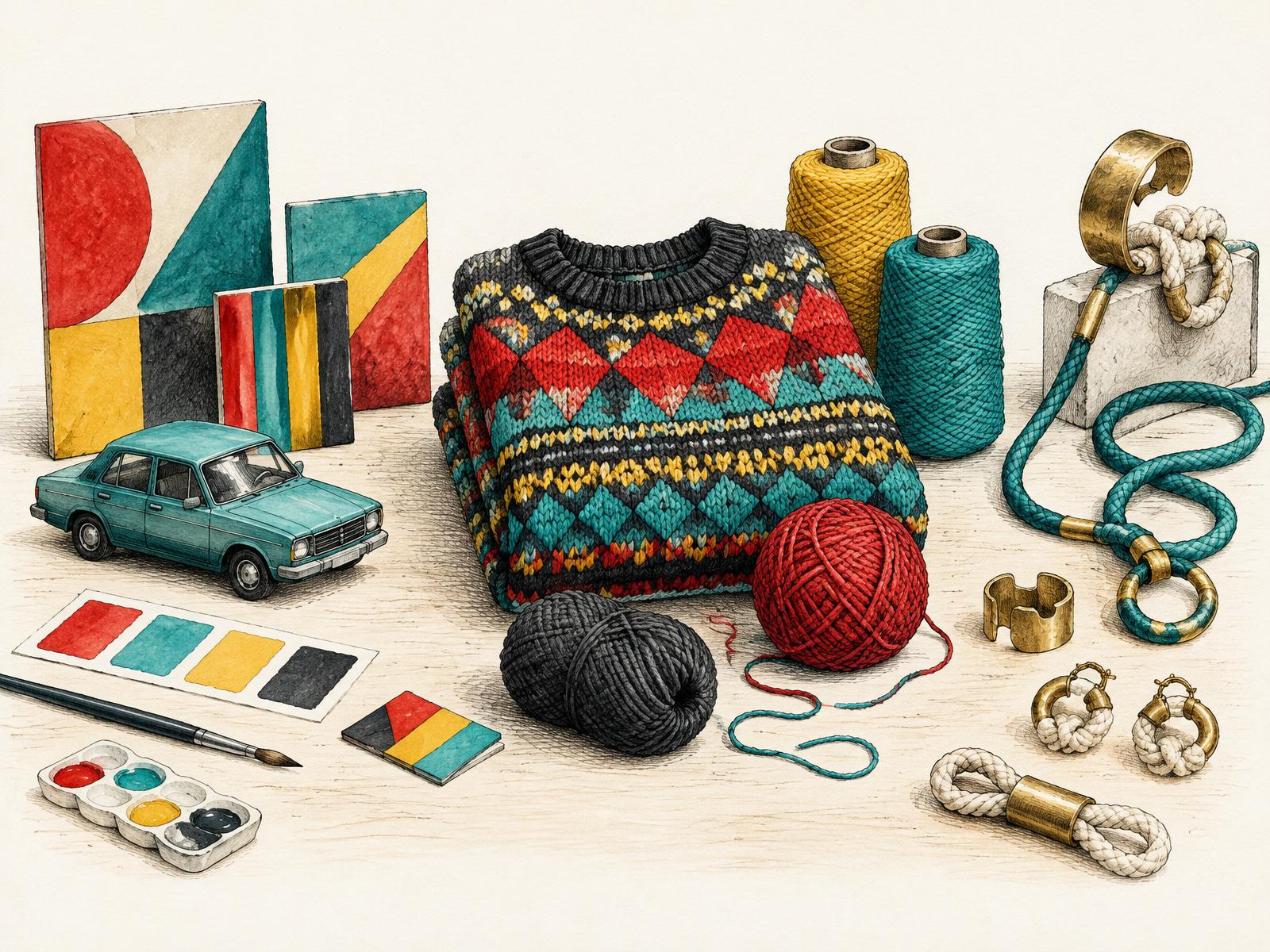
If Esther Mahlangu’s BMW pulled up beside you at a robot, you might miss the green light. Fair enough. A silver sedan is one thing. A car whose bonnet is covered in vivid blocks of colour is asking you to reconsider what a bonnet is for.
That question turns out to be a useful way into South African design. What else could a car be? What could a jersey carry besides warmth? And when did rope get permission to dress better than the rest of us?
Three South African creatives offer very different answers. Together they illustrate a design direction worth watching: what happens when makers bring a familiar skill or material into an unexpected setting.
Esther Mahlangu gave the bonnet a new job
In 1991, Esther Mahlangu painted a BMW 525i, becoming the first woman and first African artist to paint a BMW Art Car. BMW’s account of the collaboration traces her practice back to learning Ndebele mural painting from her mother and grandmother. The car later featured in her 2024 retrospective at the Iziko South African National Gallery.
Look at the car and try to follow one shape. Your eye moves across a panel, catches a change in direction and gets pulled towards another colour. The vehicle gives the painting a surface that curves, breaks and picks up again. A door seam becomes something to work with.
There’s a useful distinction for anyone commissioning work. It’s one thing to ask a designer to find a pattern that looks suitably local. It’s another to bring in an artist with a practice of her own and give her a surface worth exploring. One of those meetings has a much better chance of ending with something you couldn’t have specified at the start.
Laduma Ngxokolo put a design education into a jersey
A jersey has a fairly clear brief in most households: keep somebody warm and, if possible, survive the wash. Laduma Ngxokolo gave knitwear another job. He drew on Xhosa design traditions to develop MaXhosa, a range that makes pattern central to the garment.
Nelson Mandela University’s account of the early project records that Ngxokolo finished his BTech in 2010 and received university help to manufacture the knitwear and start his business. Its account also describes practical hurdles, including access to suitable machinery and buying raw materials in quantities a small business could afford.
That second part can vanish when we look at a finished piece. We see the colour and the repeat. We don’t see someone working out how to get a knitting machine to do what the drawing promises.
It’s worth keeping that person in mind during your next design review. Invite whoever will make the thing while there’s still time to change it. They may have a better way of getting the idea into the world. At the very least, they can explain why the beautiful curve in slide nine is about to become the most expensive curve in Gauteng.
Katherine Mary Pichulik gave rope an evening out
At PICHULIK’s Cape Town studio, the label founded by Katherine-Mary Pichulik describes a team of women making jewellery by hand. Its materials include repurposed polypropylene rope and cast brass. The rope has a visible texture and can hold a sweeping line; paired with metal, it can give a piece the scale and shape of a small sculpture.
Rope is an unlikely candidate for the jewellery box. Perhaps that’s why the pieces are fun to look at. You recognise the material and then have to think again about what it can do. It’s a small pleasure, like discovering the quiet person at the braai has been holding back the best story all afternoon.
For a practical studio exercise, take a material you normally hide or throw away and make three rough samples with it. Bend it, layer it or try it alongside something with a different finish. Ask the maker what will last and what will fall apart. The exercise is cheap enough to do before somebody asks for a full collection and a launch film.
Look a little closer to home
These three stories offer a place to start your next brief. Ask what knowledge the project could make visible, who already has it and what they’d need to make something new with you. Put their fee and credit in the plan from the beginning.
For more local surprises, meet ten South African inventors whose work travelled further than their names. Then see what happens when a trendy rebrand meets the family WhatsApp group.
Making work worth a second look? List your agency on CreH8ive or sign up for The CreH8ive Times for more stories about the people behind it.
And if the robot turns green while you’re still admiring the bonnet, the car behind you will supply an editorial note.
Keep reading

David and Goliath
Brandon Thomas brought AI to a software fight and gave creatives something to talk about
Al Chapo Tshabalala — 4 min

South Africans Built an AI Companion for the Journey. Our Traffic Has Kindly Provided the Time.
HeyJabba, a voice-first AI companion from Johannesburg's Black and Yellow Group, offers a little conversation for the long, slow drive home.
Al Chapo Tshabalala — 5 min

The Best Agency Handover Lets Someone Actually Go on Holiday
A well-prepared handover, clearly named files and a colleague with room to help: the small agency habits that let a holiday stay a holiday.
Al Chapo Tshabalala — 4 min