David and Goliath
Brandon Thomas brought AI to a software fight and gave creatives something to talk about
Al Chapo Tshabalala — 4 min
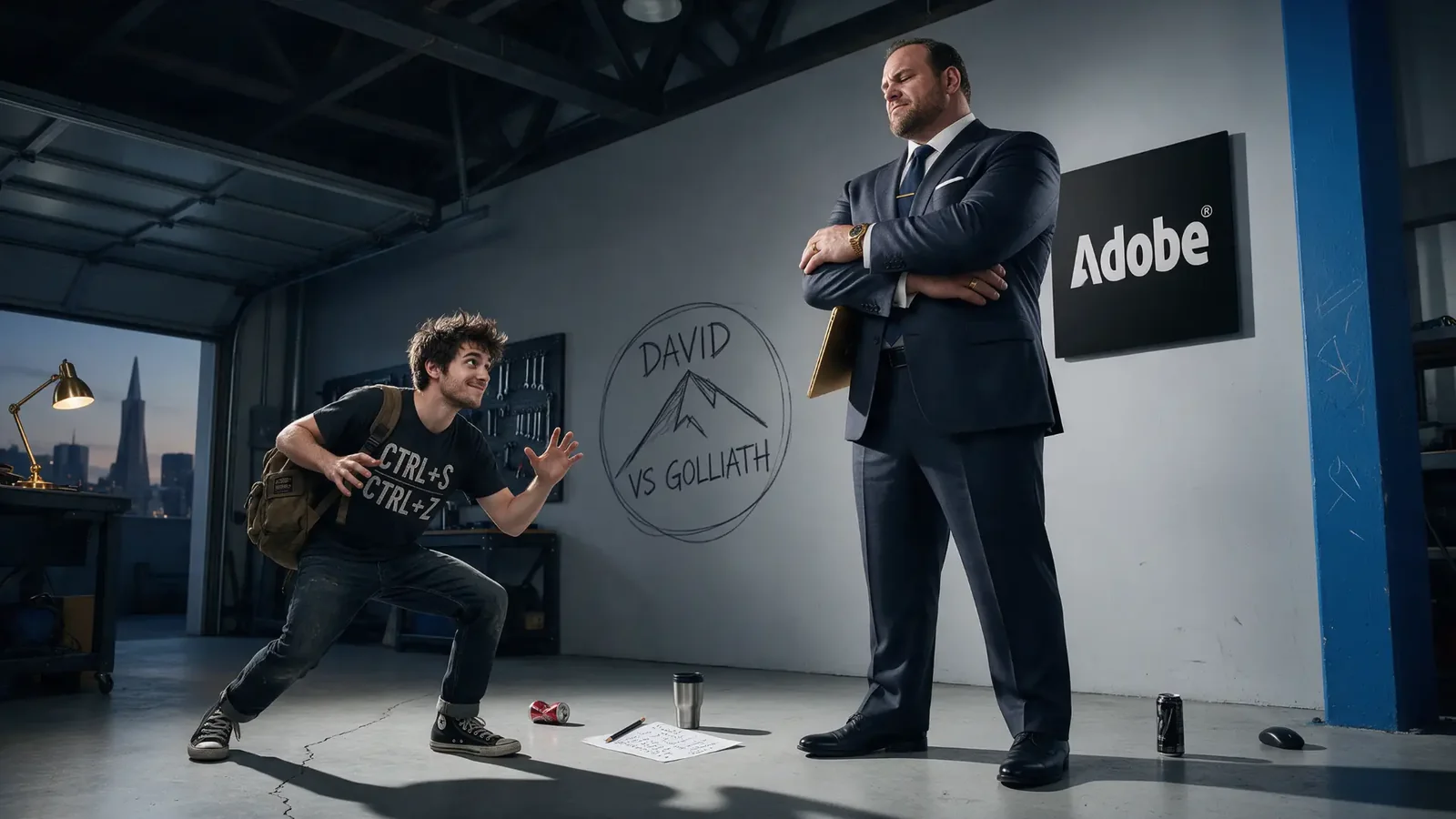
Most people annoyed by a software subscription complain to a colleague, investigate alternatives and eventually return to work because the client needs the artwork by four.
Brandon Thomas took a rather more ambitious route.
The developer behind ArtCraft began building open-source alternatives to some of Adobe’s best-known creative applications, using AI to help write the software.
It is a compelling David and Goliath story. On one side, an established creative-software giant. On the other, an engineer with a substantial technical background, an AI coding assistant and apparently very little interest in choosing a relaxing hobby.
But before anybody cancels their subscription and announces liberation in the studio WhatsApp group, there is a detail worth keeping: this is an unfolding challenge, not a completed conquest.
It began with a very modern irritation
Writing under the username echelon on Hacker News, Thomas said cancellation-fee frustrations helped motivate the project. In the same discussion, he described using Claude to create open-source implementations targeting seven Adobe applications. His public GitHub profile identifies him as ArtCraft’s founder, an engineer and a filmmaker. (Thomas’s account, GitHub profile)
There is something wonderfully recognisable about an administrative annoyance becoming a personal mission.
You thought you were ending a subscription. Suddenly you are considering a career in competitive software development.
Most of us would struggle to locate the correct account-settings page. Thomas began building alternatives to the things people were paying for.
That is a fairly decisive escalation.
Seven familiar jobs with new names
The initial ambition covered image editing, vector illustration, video editing, photography, PDFs, motion graphics and page layout—the territory associated with Photoshop, Illustrator, Premiere Pro, Lightroom, Acrobat, After Effects and InDesign.
The ArtCraft family includes PhotoCraft, VectorCraft, FilmCraft, LightCraft, PdfCraft, EffectCraft and DesignCraft. Its official website now lists a wider collection of applications, offering open-source tools without a required subscription. (ArtCraft)
For a freelancer doing monthly expenses, that proposition has obvious appeal.
Creative software sits in the same uncomfortable spreadsheet as electricity, internet access and the chair you keep promising to replace. Anything suggesting another route deserves a look.
Still, “an alternative exists” and “this can replace everything my studio relies on” are two different sentences. A great deal of professional life happens in the gap between them.
What does “copied Adobe” actually mean?
The shorthand makes a cracking headline. It also needs unpacking.
PhotoCraft’s repository describes the project as a clean-room reimplementation: new software intended to reproduce familiar functionality, rather than a release of Adobe’s proprietary source code. The project says it works from public specifications and observed behaviour.
That is the project’s description of its approach, not an independent legal verdict.
The distinction matters. Building another application that tackles familiar tasks is different from acquiring somebody else’s source code and changing the name above the door. (PhotoCraft repository)
The interesting question for a creative user is what happens when the software meets actual work.
A recognisable toolbar is encouraging. So is finding the shortcut your fingers already know.
Then comes the layered client file, the unusual font, the export requirement and the person at the printer asking why something has shifted three millimetres.
Suddenly the battle has moved beyond appearances.
David still has to deliver the artwork
To its credit, PhotoCraft’s own documentation calls it an early alpha and explicitly says it is not yet a replacement for daily professional Photoshop work. It identifies gaps including typography, professional workflows and plug-in compatibility. (PhotoCraft’s status notes)
That honesty makes the story more interesting.
We can admire the ambition without pretending the finish line has disappeared. Building an application is one achievement. Earning the trust of people whose livelihoods depend on it is another.
Imagine an entirely fictional designer trying a new editor on a personal project. She enjoys exploring it. Something breaks. She reports the problem and returns later to see whether it has improved.
Now imagine the same experiment on a national campaign thirty minutes before delivery.
Same software. Considerably different blood pressure.
Curiosity deserves room. So does a sensible testing process.
The giant has acquired an interesting neighbour
The real significance of ArtCraft may be the question it puts on the table.
How much can a determined developer now attempt with AI assistance? And what will persuade professionals to stay with established software when more alternatives begin looking familiar?
Those questions do not require us to declare Adobe defeated.
Nor do they require us to dismiss Thomas’s work because it remains unfinished. An ambitious project can be promising and imperfect at the same time. Most creative people should recognise the condition. We have all presented a first draft.
For South African agencies, students and independent makers, the hopeful part is choice: more opportunities to explore, learn and potentially contribute to the tools we use.
The useful response is to investigate the work, test its claims and judge progress by what it can reliably do.
David has turned up.
Goliath has not fallen.
And somewhere in an agency, somebody has already asked whether the new software can open the file they saved in 2018.
For more stories about unexpected challengers and creative ingenuity, sign up for the CreH8ive newsletter.
The next interesting development may arrive before the next renewal reminder.
Keep reading
South Africans Built an AI Companion for the Journey. Our Traffic Has Kindly Provided the Time.
HeyJabba, a voice-first AI companion from Johannesburg's Black and Yellow Group, offers a little conversation for the long, slow drive home.
Al Chapo Tshabalala — 5 min
The Best Agency Handover Lets Someone Actually Go on Holiday
A well-prepared handover, clearly named files and a colleague with room to help: the small agency habits that let a holiday stay a holiday.
Al Chapo Tshabalala — 4 min

ChatGPT Ads Have Landed in South Africa (And Your Client Has Already Asked for a Quote)
A client email at 8:03 a.m., a new ad platform and a plot twist: South Africans can see the ads, but local businesses can't buy them yet. Here's the calm version of the story.
Al Chapo Tshabalala — 4 min