10 South African Inventors Who Made It Big While We Were Looking Somewhere Else
Pool cleaners, Nobel Prizes and a bar of soap — ten inventors whose work reached the world while we were watching something else.
Al Chapo Tshabalala — 6 min
South Africans are very good at announcing when somebody famous once went to school here.
An actor mentions Durban in an interview and, within minutes, the family WhatsApp group has established which aunt apparently knew his mother.
Our inventors deserve the same enthusiasm.
Behind familiar pool cleaners, medical breakthroughs and sporting technology are South African minds whose names do not always get the attention their work does.
Some achieved commercial success. Others earned international scientific recognition. Several built their careers abroad, and one made South Africa his adopted home. Their stories are bigger than a bank balance—and considerably more interesting than another celebrity’s morning routine.
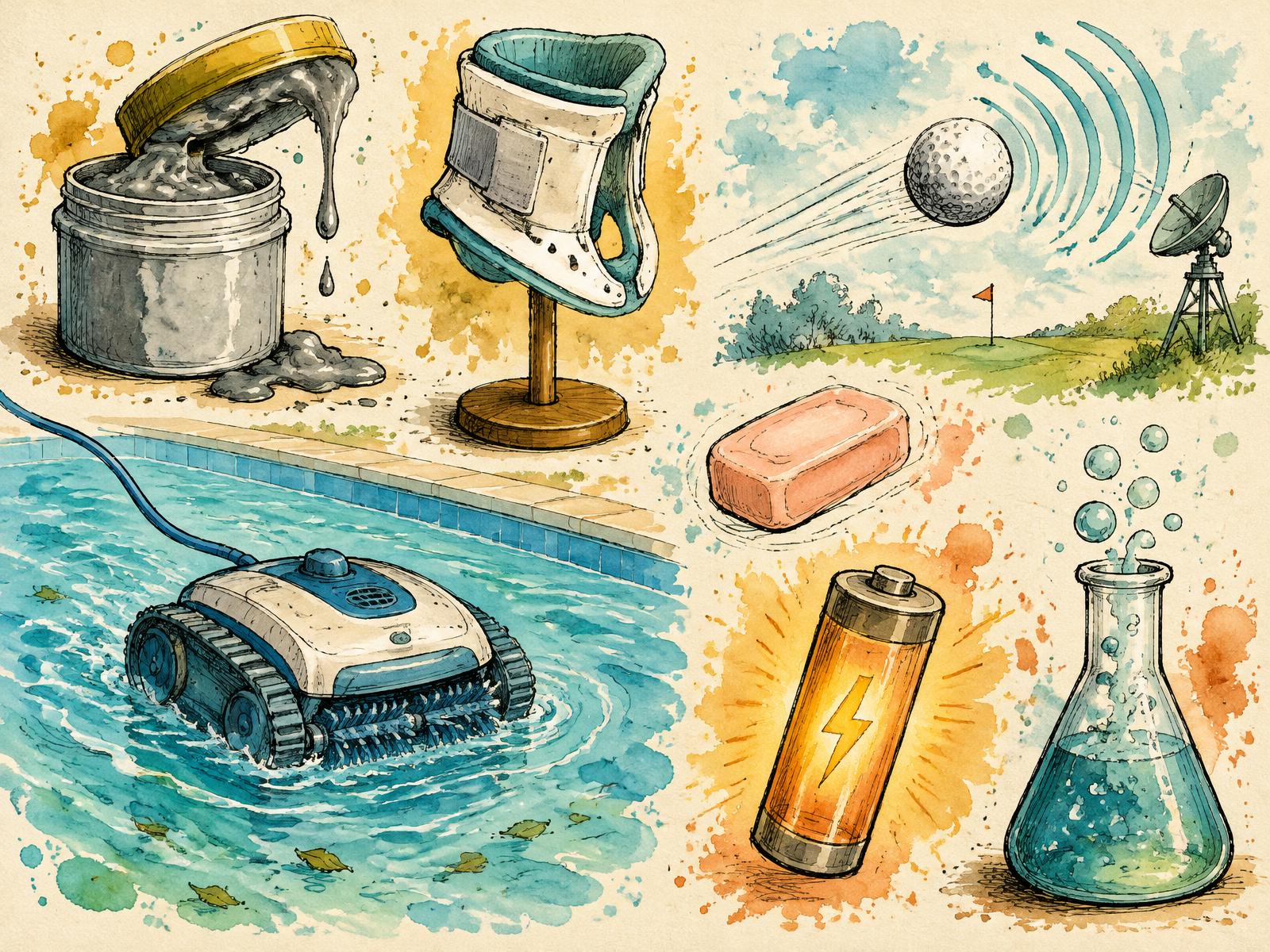
1. George Pratley gave broken things another chance
The invention: Pratley Putty
Before becoming a familiar name in repairs, George “Monty” Pratley was solving a specific engineering problem: securing electrical terminals inside a junction box.
Working with chemist Frank Robinson, he developed the epoxy putty that became Pratley Putty. A practical solution grew into a product sold far beyond its original purpose.
There is something deeply South African about building a business around the belief that the broken thing can probably still be fixed.
Preferably before somebody suggests buying a new one.
2. Ferdinand Chauvier helped us stop spending Saturdays cleaning the pool
The invention: Kreepy Krauly
Chauvier brought his family from the then Belgian Congo to South Africa in 1951. A hydraulics engineer, he later developed the Kreepy Krauly after his son Daniel identified how much pool owners disliked cleaning their pools.
According to the company’s history, early machines used wood and rubber tubing. The invention went on to reach international markets.
An immigrant family, an everyday frustration and some determined engineering: a much better origin story than “we wanted to disrupt the leisure ecosystem”.
He helped people enjoy their pools. That was plenty.
3. Allan Cormack helped doctors see inside us
The breakthrough: the mathematics behind CT scanning
Johannesburg-born physicist Allan Cormack developed mathematical work fundamental to computed tomography. He shared the 1979 Nobel Prize in Physiology or Medicine with Godfrey Hounsfield.
The credit matters: Cormack did not single-handedly build every part of the CT scanner. His contribution helped make an extraordinary medical technology possible.
Some people use mathematics to calculate whether the restaurant bill has been split fairly.
Cormack helped turn it into a way to look inside the human body.
Source: University of Cape Town
4. Max Theiler took on something considerably worse than an annoying mosquito
The breakthrough: a yellow fever vaccine
South African-born Max Theiler’s research led to an effective yellow fever vaccine. He received the 1951 Nobel Prize in Physiology or Medicine for his work on the disease and how to combat it.
This was international scientific work, undertaken at the Rockefeller Foundation—not a solo discovery made in somebody’s garage.
Still, it deserves a place in our national conversation.
We can celebrate a winning try and a life-saving scientific breakthrough. There is room for both on the group chat.
5. Trevor Wadley made measuring the distance a much bigger deal
The invention: the Tellurometer
Working at the CSIR, Wadley developed the Tellurometer, a pioneering instrument that used microwaves to measure distances accurately.
It transformed surveying, and the company manufacturing it held a leading market position for more than 25 years, according to the CSIR.
The name sounds like something a science teacher would wheel into class before everyone became nervous.
The achievement was enormous: helping people measure land more efficiently and accurately.
6. Selig Percy Amoils brought precision cooling into eye surgery
The invention: a cryosurgical probe
Johannesburg-born ophthalmologist and inventor Selig Percy Amoils developed a cryoprobe in the 1960s that advanced cataract and retinal surgery.
His work earned international recognition, including a Queen’s Award.
This is the kind of invention that rarely gets discussed around a braai because explaining it takes longer than saying “he made an app”.
It deserves the extra minute.
A carefully engineered medical instrument can change lives without ever becoming a household name.
Source: South African government’s Ubuntu magazine
7. Chris Leatt turned concern for riders into protective equipment
The invention: the Leatt neck brace
After witnessing a fatal motorcycle accident, South African doctor Chris Leatt began developing a neck protection system for riders.
The resulting brace became the foundation of an international protective-equipment business, with research and development rooted in Cape Town.
Here is an invention born from a deeply human question: how could this be safer?
The branding opportunity came afterwards. The reason to build it came first.
8. Henri Johnson gave sporting arguments some actual measurements
The invention: FlightScope ball-tracking technology
Johnson founded FlightScope in 1989, initially working with projectile-tracking technology for defence. Its radar expertise later found applications in sports, including golf.
FlightScope equipment has been used internationally by instructors, club fitters and professional players.
For golfers, that means detailed information about what the ball actually did.
A difficult development for anyone whose preferred explanation has always been “the wind”.
Technology cannot repair every sporting excuse, but it can provide an awkwardly accurate starting point.
9. Michael Thackeray helped advance the batteries powering modern life
The inventions: improved lithium-ion battery materials
Thackeray began his battery-research career at South Africa’s CSIR before moving to Argonne National Laboratory in the United States.
His contributions include the development of important electrode materials. Argonne reported in 2022 that he held 65 patents and had been elected a Fellow of the National Academy of Inventors.
He did not invent the entire lithium-ion battery alone. His achievements belong within a much wider scientific effort.
That still leaves plenty to celebrate whenever a rechargeable device helps us through the day.
Source: Argonne National Laboratory
10. Ludwick Marishane made a waterless wash an internationally recognised idea
The invention: DryBath
Limpopo-born Marishane developed DryBath, a cleansing product designed for use without a conventional bath or shower.
As a UCT student, he won the 2011 Global Student Entrepreneur Award, emerging from a competition involving nearly 2,000 students from 42 countries.
His place here rests on documented international recognition, rather than an invented claim that he became a billionaire.
A young South African took an everyday problem seriously enough to develop a product and bring it onto a global stage.
That is an achievement worth knowing.
Source: University of Cape Town
The next good idea might sound ordinary at first
These stories begin with wonderfully practical concerns.
A pool needs cleaning. A rider needs protection. A measurement needs to be accurate. A family needs access to something useful.
The breakthroughs came from people who kept working on those problems—with collaborators, research, testing and persistence.
So the next time somebody says, “Surely there must be a better way,” give them a moment.
They might be complaining.
They might also be getting started.
Keep reading
When the Client Says Everyone Is the Audience, Bring an Extra Chair
Al Chapo Tshabalala — 4 min
A Brilliant South African Idea Turns One Creative Day Into Books for Children
Al Chapo Tshabalala — 4 min
Your Trendy Rebrand Is About to Meet the Family WhatsApp Group (and It’s Going to Be Okay)
Al Chapo Tshabalala — 5 min